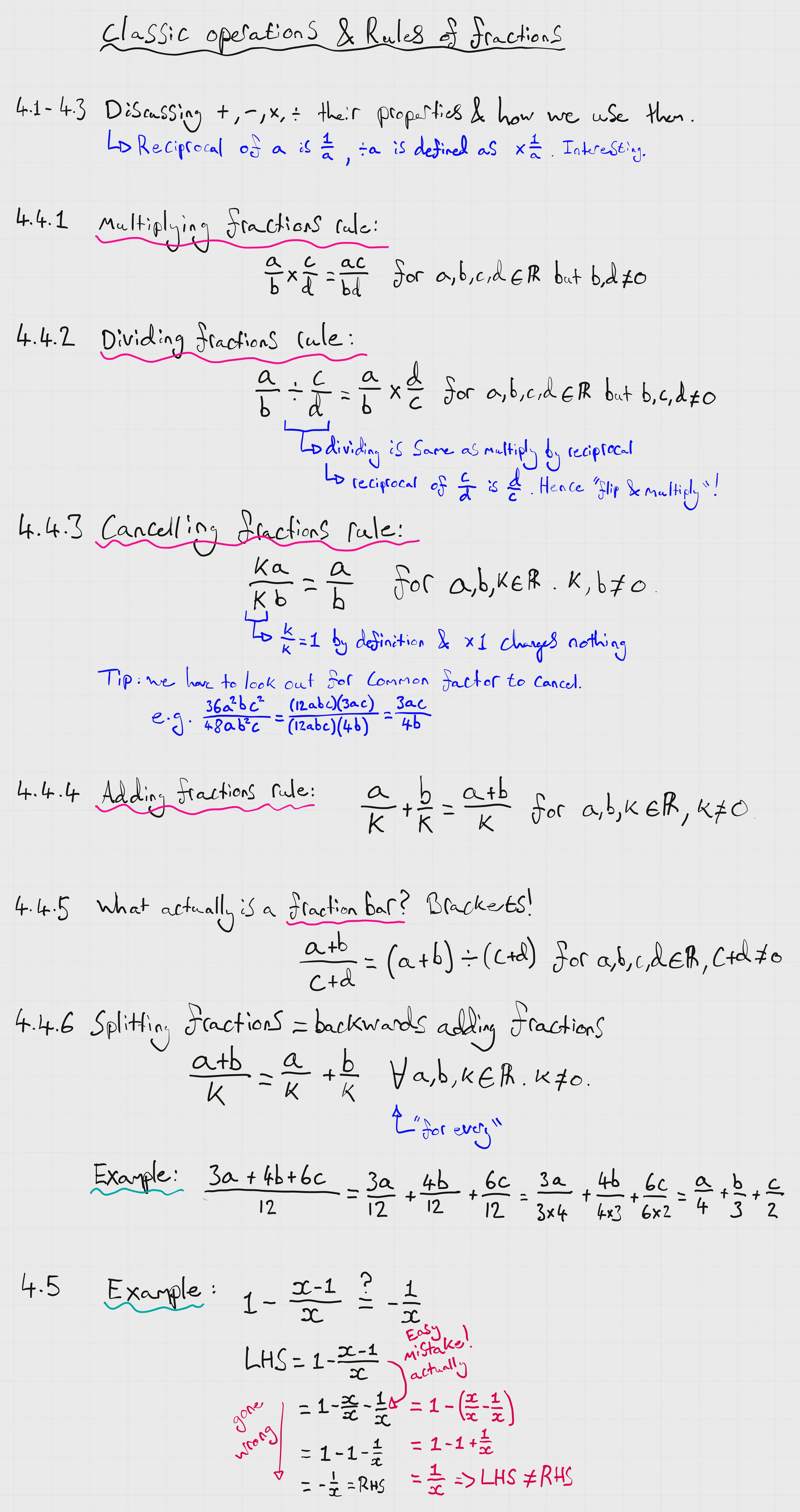
Read First: I would advise reading this page and thinking about the contents, then summarising what you find significant or new in your own concise conclusions.
Topic: This page is about defining the assumptions and mechanics of the classic operations.
To see what this looks like, here are my notes for this page. On a descriptive page like this, I only note the headlines, not everything I read, as long as I already understand it well.
Only the rules for fractions are explicitly examined but I will reference some of these properties when we derive new rules later.
How to support this course
I plan to finish writing up the whole course as a free online revision textbook. If you'd like to help, you can:
Share these resources with anyone who might find them useful
You don’t need to memorise anything here. You only need to make sure your assumptions of what you can and can’t do with the classic operations are correct. The goal is to deepen understanding of what we take for granted, and give you a small taste of how you end up proving the basics at university.
What Is an Operator?
Definition: An operator is a symbol for a mathematical action. On its own it means nothing: it needs something to operate on, and it gives back one result.
There are many operators in maths, but the classic four, +, −, × and ÷, are the ones we use most. They each have properties we’ll reference when we derive new rules later.
Definitions: Rigorously defining these operations can become quite involved, but summarised for whole numbers:
Addition combines two amounts: 3+4 means start at 3 and count on 4, giving 7.
Subtraction undoes addition: 7−4 asks what we add to 4 to make 7, which is 3.
Multiplication is repeated addition: 3×4 means three lots of 4, so 4+4+4=12.
Division undoes multiplication: 12÷4 asks how many 4s make 12, which is 3.
The minus sign is unusual, because it can also act on just one number: −3 means “the negative of 3”.
Inverses & Identities
To see exactly how subtraction and division undo the other two, we need two special kinds of number.
Identities (Changing Nothing)
For addition and multiplication, there’s a number that changes nothing, called the identity.
The additive identity is 0, because a+0=a.
The multiplicative identity is 1, because a×1=a.
Conclusion: For any a∈R:
a+0=aanda×1=a
Inverses (Undoing an action)
For addition and multiplication, numbers have inverses, which take them back to the identity.
The additive inverse of a is −a, because a+(−a)=0, returning to the identity.
The multiplicative inverse of a is a1, because a×a1=1. That’s the reciprocal, and it only exists for a=0, because we can’t divide by zero.
This reveals what subtraction and division really are:
5−3=5+(−3)and6÷2=6×21
Subtracting is defined as adding the additive inverse, and dividing is multiplying by the reciprocal.
Conclusion: Every number has a negative, and every non-zero number has a reciprocal. Subtraction and division are just addition and multiplication by these inverses. For any a,b∈R:
a−b=a+(−b)anda÷b=a×b1,b=0
So what properties do the classic operations have?
The Commutative Property (Order Doesn’t Matter)
The commutative property says we can swap the order of the two numbers without changing the result. Addition and multiplication are commutative: 2+3=3+2 and 2×3=3×2.
Subtraction and division are not: 5−3=2, but 3−5=−2. And 6÷2=3, but 2÷6=31.
Conclusion: For any a,b∈R:
a+b=b+aanda×b=b×a
The Associative Property (Brackets Don’t Matter)
The associative property says that when we use the same operation twice, we can choose which pair to work out first without changing the result. Addition and multiplication are associative: (2+3)+4=2+(3+4) and (2×3)×4=2×(3×4).
Subtraction and division are not: (8−4)−2=2, but 8−(4−2)=6. And (8÷4)÷2=1, but 8÷(4÷2)=4.
Conclusion: For any a,b,c∈R, the brackets can be left out:
(a+b)+c(a×b)×c=a+(b+c)=a+b+c=a×(b×c)=a×b×c
The Distributive Property (Expanding Brackets)
The distributive property says that multiplying a sum gives the same result as multiplying each part of it, then adding. Multiplication distributes over addition and subtraction: 3×(4+5)=3×4+3×5 and 3×(5−2)=3×5−3×2.
Conclusion: For any a,b,c∈R:
a(b+c)a(b−c)=ab+ac=ab−ac
Showing this in practice with fractions
At A-Level you never need to name-drop anything above, like the multiplicative identity or additive inverse, or the properties of addition or multiplication. However, you do use these properties all the time, which is why I think it is important to hear them clearly stated.
Below I’m going to outline how these relate to rules surrounding fractions, which you do need to be able to use, and will be examined on using correctly (you will have met these rules before).
I will reference the above to show why the below works, which is more like what you do at university, but your goal is to make sure you’ve internalised how to use the rules correctly. You can test that with the questions at the end.
Multiplying Fractions
Key Example: Using these properties, we can see how multiplying fractions really works:
The reciprocal of 75 is 57, because 75×57=3535=1. That’s where the “flip and multiply” rule comes from.
Conclusion:ba÷dc=ba×cd, for a,b,c,d∈R,b,c,d=0.
Cancelling Fractions (Which Is Really Multiplying by One)
Dividing any non-zero number by itself is the same as multiplying it by its inverse, so the result is 1.
e.g. aa=a×a1=1
And multiplying by 1, the identity, changes nothing. So when the top and bottom of a fraction share a factor, we can cancel it.
Key Example: In practice, we cross out the matching factors:
2×2×22×2×2×2×2=2×2×22×2×2×2×2=12×2=4
Behind the scenes, we’re multiplying by one:
2×2×22×2×2×2×2=12×2×2×2×22×2×2=4×1=4
We cancel out 3 matching factors of 2 from both the numerator and denominator, leaving 5−3=2 factors on top.
Note: Only factors cancel, meaning things multiplied by the rest of the top or bottom. Terms that are added don’t.
Conclusion:kbka=ba, for a,b,k∈R,k,b=0.
Adding Fractions
With the same denominator, the distributive property does the work:
72+73=2×71+3×71=(2+3)×71=75
With different denominators, there’s no common factor to take out. So first we multiply each fraction by aa=1, which changes nothing, choosing a to make the denominators match. It’s cancelling in reverse:
21+31=21×33+31×22=63+62=65
Subtracting works the same way, since it’s adding the negative.
Conclusion:ka+kb=ka+b, for a,b,k∈R,k=0. If the denominators differ, multiply by one to make them match first.
The Fraction Bar Is a Bracket
A fraction bar divides the whole top by the whole bottom: 26+4 means (6+4)÷2=5, not 6+4÷2=8.
This matters most when subtracting:
75−72+1=75−(2+1)=72
Without the brackets we’d get 75−2+1=74, which is wrong.
Conclusion:c+da+b=(a+b)÷(c+d), for a,b,c,d∈R,c+d=0.
Splitting a Fraction
Reading Adding Fractions backwards, we can split a sum on top:
26+4=26+24=3+2=5
But not a sum on the bottom: 2+412=2, while 212+412=9. The top is multiplied by k1, so the distributive property applies. The bottom’s sum is stuck inside a reciprocal, and there’s no property that spreads a reciprocal over a sum.
Conclusion:ka+b=ka+kb, for a,b,k∈R,k=0. A sum on the bottom can’t be split.
Is This Equal?
Again, the goal here is that you’re confident enough in what you can and can’t do with these operations that you always write something equal to what came before. Understanding the mechanics of these operations, and whether or not each step is equal, is the foundation of that.
Below, we name every step, so you can see where each one comes from. To show two things are not equal, one number that breaks it is enough.
Note: Each working starts from the LHS and ends with a “Hence” line, saying whether LHS=RHS. It’s a good way to communicate with the reader (or examiner).
The 3 divides the x as well as the 6. Try x=3: the LHS is 3, but the RHS is 5. Hence LHS=RHS.
Key Example 3: For x=0, is 1−xx−1=?−x1?
LHS=1−xx−1=xx−xx−1=xx−(x−1)=xx−x+1=x1using 4.4.3 cancelling in reverseusing 4.4.4 adding fractions and 4.4.5 fraction barusing 4.3.3 distributivity
Forgetting the brackets gives xx−x−1=−x1, which is the RHS. Hence LHS=RHS.
Question: For x=0, is x6÷x3=?2? Challenge: name each step you use.
Worked solutionLHS=x6÷x3=x6×3x=x×36×x=3×x2×3×x=2using 4.4.2 dividing fractionsusing 4.4.1 multiplying fractionsusing 4.3.1 commutativity and 4.3.2 associativityusing 4.4.3 cancelling
Hence LHS=RHS.
Question: For any x, is 2x+3x=?65x? Challenge: name each step you use.
Worked solutionLHS=2x+3x=2x×33+3x×22=63x+62x=63x+2x=65xusing 4.4.3 cancelling in reverseusing 4.4.1 multiplying fractions and 4.3.1 commutativityusing 4.4.4 adding fractionsusing 4.3.3 distributivity
Hence LHS=RHS.
Question: For x=0 and x=−4, is x+412=?x12+3?
Worked solution
A sum on the bottom can’t be split (4.4.6). Try x=4: the LHS is 812=23, but the RHS is 3+3=6. Hence LHS=RHS.
Right, that’s enough revisiting the basics with more mathematical rigour. It’s time to start building the A-Level material on top of our solid foundations. From now on, I would advise that your notes get more detailed and you keep an eye out for all the new rules you need to use. Here we go!