← Daruma Education

Rules of Indices

How to use this page
  • Rigorous Notes: For this page, I’d make notes on each rule individually. I’d read its derivation to see why it works. In my rough work, I’d try the rule with new numbers and work through any variations or new ingredients I can think of. Then I’d neatly write up each rule with any notes and my own key examples.
  • Topic: Building every rule of indices from a single definition, then applying them in all the skills we need.
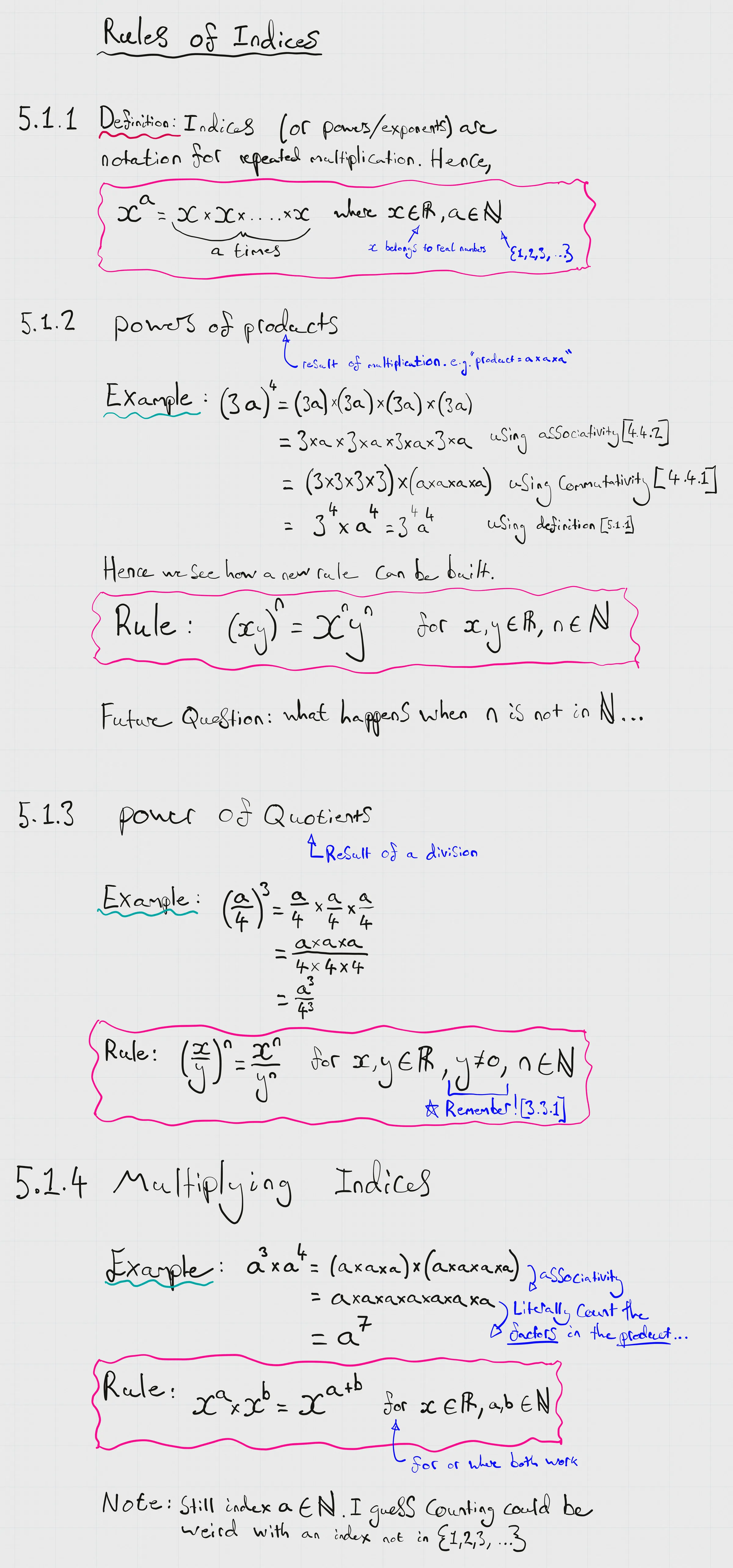
  • To see what this looks like, here are my notes for the first four rules.
How to support this course

I plan to finish writing up the whole course as a free online revision textbook. If you'd like to help, you can:

This is the first page where you’ll definitely encounter new concepts, especially in the application section. Time for your notes to get detailed.

Rather than memorising a list of rules, we’ll work each one out for ourselves, starting from a single definition. On this page we’ll:

Deriving the Rules from First Principles

Defining Indices

Indices are a shorthand for repeated multiplication. You’ll hear the terms indices, powers and exponents used interchangeably.

Definition: For a base number xx with index aa, we define the operation as:

xa=x×x×⋯×x⏟a timesfor x∈R,  a∈Nx^a = \underbrace{x \times x \times \dots \times x}_{a \text{ times}} \qquad \text{for } x \in \mathbb{R}, \; a \in \mathbb{N}

Note: x∈Rx \in \mathbb{R} translates to xx is a number from the set of real numbers (any number on the number line, including ones whose decimals never end, such as π\pi or 2\sqrt{2}). Then a∈Na \in \mathbb{N} means that aa is a natural number, or a counting number, or a positive integer e.g. {1,2,3,… }\{1, 2, 3, \dots\}.

For clarification, the index (or power, or exponent) is the small raised number aa, and xx is the base. The whole operation is called raising xx to the power aa, so we read 232^3 as “2 raised to the power 3”.

Starting with this definition, we can algebraically deduce other rules.

Powers of Products

Firstly, recall that a product is the result of a multiplication, such as 2×32 \times 3. Now, our first deduction uses only the definition and the associative and commutative properties of multiplication, which we covered in section The Classic Operations.

Key Example:

(2×3)3=(2×3)×(2×3)×(2×3)=(2×2×2)×(3×3×3)=23×33\begin{aligned} (2 \times 3)^3 &= (2 \times 3) \times (2 \times 3) \times (2 \times 3) \\ &= (2 \times 2 \times 2) \times (3 \times 3 \times 3) \\ &= 2^3 \times 3^3 \end{aligned}

Note: From the first line to the second, we drop the brackets (associative) and reorder the factors (commutative).

Consider: How does (2x)3(2x)^3 expand in the same way?

Conclusion: The same regrouping works for any two real numbers, raised to any natural number power:

(xy)n=xy×xy×⋯×xy⏟n times=(x×⋯×x⏟n times)×(y×⋯×y⏟n times)=xnynfor x,y∈R,  n∈N\begin{aligned} (xy)^n &= \underbrace{xy \times xy \times \dots \times xy}_{n \text{ times}} \\ &= (\underbrace{x \times \dots \times x}_{n \text{ times}}) \times (\underbrace{y \times \dots \times y}_{n \text{ times}}) \\ &= x^n y^n \qquad \text{for } x, y \in \mathbb{R}, \; n \in \mathbb{N} \end{aligned}

Powers of Quotients

Recall that a quotient is the result of a division, such as 23=2÷3\dfrac{2}{3} = 2 \div 3. Quotients work the same way, because we multiply fractions by multiplying the numerators together and the denominators together.

Key Example:

(23)3=23×23×23=2×2×23×3×3=2333\begin{aligned} \left(\frac{2}{3}\right)^3 &= \frac{2}{3} \times \frac{2}{3} \times \frac{2}{3} \\ &= \frac{2 \times 2 \times 2}{3 \times 3 \times 3} \\ &= \frac{2^3}{3^3} \end{aligned}

Consider: How does (43)4\left(\dfrac{4}{3}\right)^4 expand in the same way?

Conclusion: The same works for any fraction, as long as the denominator is not zero:

(xy)n=xy×xy×⋯×xy⏟n times=x×⋯×x⏞n timesy×⋯×y⏟n times=xnynfor x,y∈R,  y≠0,  n∈N\begin{aligned} \left(\frac{x}{y}\right)^n &= \underbrace{\frac{x}{y} \times \frac{x}{y} \times \dots \times \frac{x}{y}}_{n \text{ times}} \\ &= \frac{\overbrace{x \times \dots \times x}^{n \text{ times}}}{\underbrace{y \times \dots \times y}_{n \text{ times}}} \\ &= \frac{x^n}{y^n} \qquad \text{for } x, y \in \mathbb{R}, \; y \neq 0, \; n \in \mathbb{N} \end{aligned}

Multiplying Indices

Key Example:

25×23=(2×2×2×2×2⏟5 times)×(2×2×2⏟3 times)=2×2×2×2×2×2×2×2⏟5+3=8 times=28\begin{aligned} 2^5 \times 2^3 &= (\underbrace{2 \times 2 \times 2 \times 2 \times 2}_{5 \text{ times}}) \times (\underbrace{2 \times 2 \times 2}_{3 \text{ times}}) \\ &= \underbrace{2 \times 2 \times 2 \times 2 \times 2 \times 2 \times 2 \times 2}_{5 + 3 = 8 \text{ times}} \\ &= 2^8 \end{aligned}

Note: Why does this work? We’re using the associative property of multiplication to drop the brackets, knowing it remains equal. This property is outlined in The Classic Operations.

Observations:

Consider: What if we swap the order to 23×252^3 \times 2^5? Can you see how the commutative property of multiplication, and of addition, both tell us we still get 282^8?

Conclusion: Extending this logic to any base number we arrive at another fundamental rule:

xa×xb=(x×x×⋯×x⏟a times)×(x×x×⋯×x⏟b times)=x×x×⋯×x⏟a+b times=xa+bfor x∈R,  a,b∈N\begin{aligned} x^a \times x^b &= (\underbrace{x \times x \times \dots \times x}_{a \text{ times}}) \times (\underbrace{x \times x \times \dots \times x}_{b \text{ times}}) \\ &= \underbrace{x \times x \times \dots \times x}_{a+b \text{ times}} \\ &= x^{a+b} \qquad \text{for } x \in \mathbb{R}, \; a,b \in \mathbb{N} \end{aligned}

Dividing Indices

Key Example 1:

25÷23=2×2×2×2×2⏞5 times2×2×2⏟3 times=2×2=22\begin{aligned} 2^5 \div 2^3 &= \frac{\overbrace{2 \times 2 \times 2 \times 2 \times 2}^{5 \text{ times}}}{\underbrace{2 \times 2 \times 2}_{3 \text{ times}}} \\ &= 2 \times 2 \\ &= 2^2 \end{aligned}

Note: Why does this work? Since any non-zero number divided by itself equals 11 (22=1\dfrac{2}{2} = 1), we can cancel out matching factors of 22. Cancelling is outlined in The Classic Operations.

Key Example 2:

23÷25=2×2×2⏞3 times2×2×2×2×2⏟5 times=12×2=122\begin{aligned} 2^3 \div 2^5 &= \frac{\overbrace{2 \times 2 \times 2}^{3 \text{ times}}}{\underbrace{2 \times 2 \times 2 \times 2 \times 2}_{5 \text{ times}}} \\ &= \frac{1}{2 \times 2} \\ &= \frac{1}{2^2} \end{aligned}

Note: Why does this lead to a different result? Division is non-commutative, 25÷23≠23÷252^5 \div 2^3 \neq 2^3 \div 2^5. This time the denominator has more factors, so the leftover factors stay on the bottom.

Observations: By cancelling out common factors in the numerator and denominator, we are always left with the difference in the total number of factors:

Conclusion: Extending this logic to any non-zero base number xx, we establish another fundamental rule, for now when a>ba > b:

xa÷xb=x×x×⋯×x⏞a timesx×x×⋯×x⏟b times=xa−bfor x∈R,  x≠0,  a,b∈N,  a>b\begin{aligned} x^a \div x^b &= \frac{\overbrace{x \times x \times \dots \times x}^{a \text{ times}}}{\underbrace{x \times x \times \dots \times x}_{b \text{ times}}} \\ &= x^{a-b} \qquad \text{for } x \in \mathbb{R}, \; x \neq 0, \; a,b \in \mathbb{N}, \; a > b \end{aligned}

Zero Index

We’ve defined what happens when the index a∈Na \in \mathbb{N}. However, we need to determine what happens when a∈{0,−1,−2,−3, ... }a \in \{ 0, -1, -2, -3, \text{ ... } \}. We’ll start with 00.

Key Example 1: Consider the expansion of these powers of 22.

23=2×2×2=8×2↑↓  ÷222=2×2=4×2↑↓  ÷221=2\begin{array}{rrll} & 2^3 &= 2 \times 2 \times 2 = 8 & \\ \scriptsize \times 2 \; \Big\uparrow & & & \Big\downarrow \; \scriptsize \div 2 \\ & 2^2 &= 2 \times 2 = 4 & \\ \scriptsize \times 2 \; \Big\uparrow & & & \Big\downarrow \; \scriptsize \div 2 \\ & 2^1 &= 2 & \end{array}

Observations:

  1. When the power increases by 11, we multiply by the base number (22) one more time.
  2. We can extend this logic the other way. When we decrease the power by 11, we do the inverse operation, dividing by 22.
    • e.g. to move down from the top row, we divide by 22. 23÷2=2×2×22=2×2=222^3 \div 2 = \dfrac{2 \times 2 \times 2}{2} = 2 \times 2 = 2^2
    • One more step down from 212^1 gives 2÷2=12 \div 2 = 1, so the pattern says 20=12^0 = 1.

Key Example 2: The division rule agrees. Working out 23÷232^3 \div 2^3 both ways:

23÷23=2×2×22×2×2=123÷23=23−3=20\begin{aligned} 2^3 \div 2^3 &= \frac{2 \times 2 \times 2}{2 \times 2 \times 2} = 1 \\ 2^3 \div 2^3 &= 2^{3-3} = 2^0 \end{aligned}

Note: Our definition only covered a∈Na \in \mathbb{N}, so 202^0 had no meaning yet. We choose 20=12^0 = 1, because it fits the pattern and keeps the division rule working.

Conclusion: The same works for any base except 00, because dividing by 00 is undefined.

x0=1for x∈R,  x≠0x^0 = 1 \quad \text{for } x \in \mathbb{R}, \; x \neq 0

Negative Indices

Key Example 1: We can take those observations and use them to expand beyond positive integer powers. We know that to decrease the power by 1 we divide the row above by the base number.

23=2×2×2=8×2↑↓  ÷222=2×2=4×2↑↓  ÷221=2×2↑↓  ÷220=1×2↑↓  ÷22−1=12×2↑↓  ÷22−2=122=14×2↑↓  ÷22−3=123=18\begin{array}{rrll} & 2^3 &= 2 \times 2 \times 2 = 8 & \\ \scriptsize \times 2 \; \Big\uparrow & & & \Big\downarrow \; \scriptsize \div 2 \\ & 2^2 &= 2 \times 2 = 4 & \\ \scriptsize \times 2 \; \Big\uparrow & & & \Big\downarrow \; \scriptsize \div 2 \\ & 2^1 &= 2 & \\ \scriptsize \times 2 \; \Big\uparrow & & & \Big\downarrow \; \scriptsize \div 2 \\ & 2^0 &= 1 & \\ \scriptsize \times 2 \; \Big\uparrow & & & \Big\downarrow \; \scriptsize \div 2 \\ & 2^{-1} &= \frac{1}{2} & \\ \scriptsize \times 2 \; \Big\uparrow & & & \Big\downarrow \; \scriptsize \div 2 \\ & 2^{-2} &= \frac{1}{2^2} = \frac{1}{4} & \\ \scriptsize \times 2 \; \Big\uparrow & & & \Big\downarrow \; \scriptsize \div 2 \\ & 2^{-3} &= \frac{1}{2^3} = \frac{1}{8} & \end{array}

Observations:

Key Example 2: The division rule agrees again. Working out 23÷252^3 \div 2^5 both ways:

23÷25=2×2×22×2×2×2×2=12223÷25=23−5=2−2\begin{aligned} 2^3 \div 2^5 &= \frac{2 \times 2 \times 2}{2 \times 2 \times 2 \times 2 \times 2} = \frac{1}{2^2} \\ 2^3 \div 2^5 &= 2^{3-5} = 2^{-2} \end{aligned}

Question: Consider a base number of 33 and the same powers. What operations are you doing to increase or decrease the power by 11?

33=32=31=30=3−1=3−2=3−3=\begin{aligned} 3^3 &= \\ 3^2 &= \\ 3^1 &= \\ 3^0 &= \\ 3^{-1} &= \\ 3^{-2} &= \\ 3^{-3} &= \end{aligned}

We observe this same behaviour for different bases. We just need to note that x≠0x \neq 0, because dividing by 00 is undefined.

x3=x×x×x×x↑↓  ÷xx2=x×x×x↑↓  ÷xx1=x×x↑↓  ÷xx0=1×x↑↓  ÷xx−1=1x×x↑↓  ÷xx−2=1x2×x↑↓  ÷xx−3=1x3\begin{array}{rrll} & x^3 &= x \times x \times x & \\ \scriptsize \times x \; \Big\uparrow & & & \Big\downarrow \; \scriptsize \div x \\ & x^2 &= x \times x & \\ \scriptsize \times x \; \Big\uparrow & & & \Big\downarrow \; \scriptsize \div x \\ & x^1 &= x & \\ \scriptsize \times x \; \Big\uparrow & & & \Big\downarrow \; \scriptsize \div x \\ & x^0 &= 1 & \\ \scriptsize \times x \; \Big\uparrow & & & \Big\downarrow \; \scriptsize \div x \\ & x^{-1} &= \frac{1}{x} & \\ \scriptsize \times x \; \Big\uparrow & & & \Big\downarrow \; \scriptsize \div x \\ & x^{-2} &= \frac{1}{x^2} & \\ \scriptsize \times x \; \Big\uparrow & & & \Big\downarrow \; \scriptsize \div x \\ & x^{-3} &= \frac{1}{x^3} \end{array}

Conclusion: Hence, we observe this rule:

x−n=1xnfor x∈R,  x≠0,  n∈Nx^{-n} = \frac{1}{x^n} \quad \text{for } x \in \mathbb{R}, \; x \neq 0, \; n \in \mathbb{N}

Note: With this, the division rule xa÷xb=xa−bx^a \div x^b = x^{a-b} now works for all a,b∈Na, b \in \mathbb{N}, whichever is larger.

Power of a Power

Now, what happens when we raise a power to another power?

Key Example:

(25)3=25×25×25=25+5+5=25×3=215\begin{aligned} (2^5)^3 &= 2^5 \times 2^5 \times 2^5 \\ &= 2^{5 + 5 + 5} \\ &= 2^{5 \times 3} \\ &= 2^{15} \end{aligned}

Note: Why does this work? Cubing means multiplying three copies of 252^5 together, so we can use the rule from Multiplying Indices. Then adding 55 three times is the same as 5×35 \times 3, because multiplication is repeated addition (The Classic Operations).

Observations:

Consider: How many factors of 33 are there in (32)4(3^2)^4?

Conclusion: Extending this logic to any base number we arrive at another fundamental rule:

(xa)b=xa×xa×⋯×xa⏟b times=xa+a+⋯+a⏞b times=xabfor x∈R,  a,b∈N\begin{aligned} (x^a)^b &= \underbrace{x^a \times x^a \times \dots \times x^a}_{b \text{ times}} \\ &= x^{\overbrace{a + a + \dots + a}^{b \text{ times}}} \\ &= x^{ab} \qquad \text{for } x \in \mathbb{R}, \; a,b \in \mathbb{N} \end{aligned}

Roots as Indices

So far every index has been a whole number. Now, what could 2122^{\frac{1}{2}} mean? Just like with zero and negative indices, we choose the meaning that keeps our rules working.

Key Example 1: Consider how

212×212=212+12=21=22^{\frac{1}{2}} \times 2^{\frac{1}{2}} = 2^{\frac{1}{2}+\frac{1}{2}} = 2^1 = 2

So 2122^{\frac{1}{2}} is a number that multiplies by itself to make 22. Both 2\sqrt{2} and −2-\sqrt{2} do that, so we choose the positive one:

212=22^{\frac{1}{2}} = \sqrt{2}

Key Example 2:

213×213×213=213+13+13=21=22^{\frac{1}{3}} \times 2^{\frac{1}{3}} \times 2^{\frac{1}{3}} = 2^{\frac{1}{3}+\frac{1}{3}+\frac{1}{3}} = 2^1 = 2 ∴213=23\therefore 2^{\frac{1}{3}} = \sqrt[3]{2}

Note: Why is there no choice this time? Only one real number cubes to make 22. Even roots, like square roots, always have a positive and a negative candidate, and we always take the positive one.

Consider: How many copies of 2142^{\frac{1}{4}} would you need to multiply together to get back to 212^1? What does that tell you 2142^{\frac{1}{4}} must be?

Conclusion: Extending this logic to any positive base number we arrive at another fundamental rule:

x1b=xbfor x∈R,  x>0,  b∈Nx^{\frac{1}{b}} = \sqrt[b]{x} \qquad \text{for } x \in \mathbb{R}, \; x > 0, \; b \in \mathbb{N}

Note: We stick to positive bases because, for example, (−4)12(-4)^{\frac{1}{2}} isn’t a real number.

Fractional Indices

Now, what about a fractional index where the numerator isn’t 11?

Key Example: Consider 8438^{\frac{4}{3}}. Since 43=13×4\dfrac{4}{3} = \dfrac{1}{3} \times 4, we can use Power of a Power to split 8438^{\frac{4}{3}} into two steps, in either order:

843=(813)4=24=16843=(84)13=40963=16\begin{aligned} 8^{\frac{4}{3}} &= \left(8^{\frac{1}{3}}\right)^4 = 2^4 = 16 \\ 8^{\frac{4}{3}} &= \left(8^4\right)^{\frac{1}{3}} = \sqrt[3]{4096} = 16 \end{aligned}

Observations:

Question: Work out 272327^{\frac{2}{3}} both ways. Which is easier?

Conclusion: Hence we build the rule:

xab=(xb)a=xabfor x∈R,  x>0,  a∈Z,  b∈Nx^{\frac{a}{b}} = \left(\sqrt[b]{x}\right)^a = \sqrt[b]{x^a} \qquad \text{for } x \in \mathbb{R}, \; x > 0, \; a \in \mathbb{Z}, \; b \in \mathbb{N}

Summary of Rules

Here’s every rule we’ve derived, in one place. If you’re unsure about any of them, click its name to go back to why it works.

SectionRuleIn symbols
5.1.1Defining Indicesxa=x×⋯×x⏟a timesx^a = \underbrace{x \times \dots \times x}_{a \text{ times}} for a∈Na \in \mathbb{N}
5.1.2Powers of Products(xy)n=xnyn(xy)^n = x^n y^n
5.1.3Powers of Quotients(xy)n=xnyn\left(\dfrac{x}{y}\right)^n = \dfrac{x^n}{y^n}
5.1.4Multiplying Indicesxa×xb=xa+bx^a \times x^b = x^{a+b}
5.1.5Dividing Indicesxa÷xb=xa−bx^a \div x^b = x^{a-b}
5.1.6Zero Indexx0=1x^0 = 1
5.1.7Negative Indicesx−n=1xnx^{-n} = \dfrac{1}{x^n}
5.1.8Power of a Power(xa)b=xab(x^a)^b = x^{ab}
5.1.9Roots as Indicesx1b=xbx^{\frac{1}{b}} = \sqrt[b]{x}
5.1.10Fractional Indicesxab=(xb)a=xabx^{\frac{a}{b}} = \left(\sqrt[b]{x}\right)^a = \sqrt[b]{x^a}

Note: Many of our deductions used natural numbers, because counting factors only works with whole numbers. We then chose meanings for zero, negative and fractional indices that keep the same rules working, which is why you can use them for any rational index.

Applying the Rules

These questions were carefully chosen to test the core skills of this topic: how the rules combine, and how they show up in real exam papers. Make sure you understand each one, and you’ll be well prepared.

When we’re solving problems, you want to consider every rule in the summary as a tool you might be expected to use.

Every rule works for any rational index: whole, negative or fractional. Just be careful with:

Negative Fractional Indices

Key Example 1: Work out 8−238^{-\frac{2}{3}}.

8−23=1823=1(83)2=122=14\begin{aligned} 8^{-\frac{2}{3}} &= \frac{1}{8^{\frac{2}{3}}} \\ &= \frac{1}{\left(\sqrt[3]{8}\right)^2} \\ &= \frac{1}{2^2} \\ &= \frac{1}{4} \end{aligned}

Note: We deal with the minus sign first using Negative Indices, then the fraction using Fractional Indices, taking the root first to keep the numbers small.

Key Example 2: Work out 4−2.54^{-2.5}.

4−2.5=4−52=1452=1(4)5=125=132\begin{aligned} 4^{-2.5} &= 4^{-\frac{5}{2}} \\ &= \frac{1}{4^{\frac{5}{2}}} \\ &= \frac{1}{\left(\sqrt{4}\right)^5} \\ &= \frac{1}{2^5} \\ &= \frac{1}{32} \end{aligned}

Note: First, we write the decimal as a fraction. Because the indices multiply (Power of a Power), we can then deal with the minus, the denominator (the root) and the numerator (the power) in any order.

Key Question 1: Work out 81−0.7581^{-0.75}.

Worked solution

Write the decimal index as a fraction first: 0.75=340.75 = \dfrac{3}{4}.

81−0.75=81−34=18134=1(814)3=133=127\begin{aligned} 81^{-0.75} &= 81^{-\frac{3}{4}} \\ &= \frac{1}{81^{\frac{3}{4}}} \\ &= \frac{1}{\left(\sqrt[4]{81}\right)^3} \\ &= \frac{1}{3^3} \\ &= \frac{1}{27} \end{aligned}

Key Question 2: Given that a=16−34a = 16^{-\frac{3}{4}} and b=8−23b = 8^{-\frac{2}{3}}, find the exact value of ab\dfrac{a}{b}.

Worked solution

Work out each one first:

a=16−34=1(164)3=123=18b=8−23=1(83)2=122=14\begin{aligned} a &= 16^{-\frac{3}{4}} = \frac{1}{\left(\sqrt[4]{16}\right)^3} = \frac{1}{2^3} = \frac{1}{8} \\ b &= 8^{-\frac{2}{3}} = \frac{1}{\left(\sqrt[3]{8}\right)^2} = \frac{1}{2^2} = \frac{1}{4} \end{aligned}

Then divide:

ab=18÷14=18×4=12\frac{a}{b} = \frac{1}{8} \div \frac{1}{4} = \frac{1}{8} \times 4 = \frac{1}{2}

Flipping a Fraction

Key Example 1: Work out (23)−2\left(\dfrac{2}{3}\right)^{-2}.

(23)−2=1(23)2=1÷2232=1×3222=94\begin{aligned} \left(\frac{2}{3}\right)^{-2} &= \frac{1}{\left(\frac{2}{3}\right)^2} \\ &= 1 \div \frac{2^2}{3^2} \\ &= 1 \times \frac{3^2}{2^2} \\ &= \frac{9}{4} \end{aligned}

Note: We use Negative Indices to move the power to the bottom, then Powers of Quotients. Dividing by a fraction is the same as multiplying by its reciprocal (the fraction flipped upside down), so the fraction flips.

Observations:

Key Example 2: Work out 0.64−120.64^{-\frac{1}{2}}.

0.64−12=(1625)−12=(2516)12=2516=54\begin{aligned} 0.64^{-\frac{1}{2}} &= \left(\frac{16}{25}\right)^{-\frac{1}{2}} \\ &= \left(\frac{25}{16}\right)^{\frac{1}{2}} \\ &= \frac{\sqrt{25}}{\sqrt{16}} \\ &= \frac{5}{4} \end{aligned}

Key Question 1: Work out (278)−23\left(\dfrac{27}{8}\right)^{-\frac{2}{3}}.

Worked solution (278)−23=(827)23=(83273)2=(23)2=49\begin{aligned} \left(\frac{27}{8}\right)^{-\frac{2}{3}} &= \left(\frac{8}{27}\right)^{\frac{2}{3}} \\ &= \left(\frac{\sqrt[3]{8}}{\sqrt[3]{27}}\right)^2 \\ &= \left(\frac{2}{3}\right)^2 \\ &= \frac{4}{9} \end{aligned}

Key Question 2: Work out 2.25−322.25^{-\frac{3}{2}}, giving your answer as a fraction.

Worked solution

Write the decimal as a fraction first, then flip it:

2.25−32=(94)−32=(49)32=(49)3=(23)3=827\begin{aligned} 2.25^{-\frac{3}{2}} &= \left(\frac{9}{4}\right)^{-\frac{3}{2}} \\ &= \left(\frac{4}{9}\right)^{\frac{3}{2}} \\ &= \left(\frac{\sqrt{4}}{\sqrt{9}}\right)^3 \\ &= \left(\frac{2}{3}\right)^3 \\ &= \frac{8}{27} \end{aligned}

Writing Terms as Powers of x

There are questions where we need all our terms to be in the form axnax^n, for some numbers aa and nn.

Key Example 1: Write 3x\dfrac{3}{\sqrt{x}} in the form axnax^n.

3x=3x12=3x−12\begin{aligned} \frac{3}{\sqrt{x}} &= \frac{3}{x^{\frac{1}{2}}} \\ &= 3x^{-\frac{1}{2}} \end{aligned}

Note: Only the xx moves to the top, so the 33 stays as it is. Watch out: 3x\dfrac{3}{\sqrt{x}} is not (3x)−12(3x)^{-\frac{1}{2}}.

Key Example 2: Write x2−42x\dfrac{x^2 - 4}{2\sqrt{x}} as a sum of powers of xx.

x2−42x=x22x12−42x12=12x2−12−2x−12=12x32−2x−12\begin{aligned} \frac{x^2 - 4}{2\sqrt{x}} &= \frac{x^2}{2x^{\frac{1}{2}}} - \frac{4}{2x^{\frac{1}{2}}} \\ &= \frac{1}{2}x^{2 - \frac{1}{2}} - 2x^{-\frac{1}{2}} \\ &= \frac{1}{2}x^{\frac{3}{2}} - 2x^{-\frac{1}{2}} \end{aligned}

Note: We split the fraction into one term per part of the numerator, then use Dividing Indices on each term.

Key Question 1: Write (2x−5)9x3x\dfrac{(2x - 5)\sqrt{9x}}{3x} as a sum of powers of xx.

Worked solution

Firstly, by Powers of Products, 9x=(9x)12=912x12=3x12\sqrt{9x} = (9x)^{\frac{1}{2}} = 9^{\frac{1}{2}}x^{\frac{1}{2}} = 3x^{\frac{1}{2}}. So:

(2x−5)9x3x=(2x−5)×3x123x=(2x−5)x12x=2x32−5x12x=2x32x−5x12x=2x12−5x−12\begin{aligned} \frac{(2x - 5)\sqrt{9x}}{3x} &= \frac{(2x - 5) \times 3x^{\frac{1}{2}}}{3x} \\ &= \frac{(2x - 5)x^{\frac{1}{2}}}{x} \\ &= \frac{2x^{\frac{3}{2}} - 5x^{\frac{1}{2}}}{x} \\ &= \frac{2x^{\frac{3}{2}}}{x} - \frac{5x^{\frac{1}{2}}}{x} \\ &= 2x^{\frac{1}{2}} - 5x^{-\frac{1}{2}} \end{aligned}

Key Question 2: Given that 4x3−6x2x2\dfrac{4x^3 - 6\sqrt{x}}{2x^2} can be written in the form 2xp−3xq2x^p - 3x^q, find the values of pp and qq.

Worked solution

Split the fraction, then use Dividing Indices on each term:

4x3−6x2x2=4x32x2−6x122x2=2x3−2−3x12−2=2x1−3x−32\begin{aligned} \frac{4x^3 - 6\sqrt{x}}{2x^2} &= \frac{4x^3}{2x^2} - \frac{6x^{\frac{1}{2}}}{2x^2} \\ &= 2x^{3-2} - 3x^{\frac{1}{2}-2} \\ &= 2x^1 - 3x^{-\frac{3}{2}} \end{aligned}

So p=1p = 1 and q=−32q = -\dfrac{3}{2}.

Equations with the Same Base

When both sides of an equation can be written as powers of the same number, we can compare the indices.

Key Example 1: Solve 4x=8x−14^x = 8^{x-1}.

4x=8x−1(22)x=(23)x−122x=23x−3⇒2x=3x−3x=3\begin{aligned} 4^x &= 8^{x-1} \\ \left(2^2\right)^x &= \left(2^3\right)^{x-1} \\ 2^{2x} &= 2^{3x-3} \\ \Rightarrow \quad 2x &= 3x - 3 \\ x &= 3 \end{aligned}

Note: We write 44 and 88 as powers of 22, then use Power of a Power. Each power of 22 is a different number, so if two powers of 22 are equal, their indices must be equal too. That’s what the ⇒\Rightarrow shows.

Consider: Check the answer. Do 434^3 and 828^2 really give the same number? How could you write both as a power of 22?

Key Example 2: Solve 9x=139^x = \dfrac{1}{\sqrt{3}}.

9x=13(32)x=131232x=3−12⇒2x=−12x=−14\begin{aligned} 9^x &= \frac{1}{\sqrt{3}} \\ \left(3^2\right)^x &= \frac{1}{3^{\frac{1}{2}}} \\ 3^{2x} &= 3^{-\frac{1}{2}} \\ \Rightarrow \quad 2x &= -\frac{1}{2} \\ x &= -\frac{1}{4} \end{aligned}

Note: The right-hand side needs Roots as Indices and Negative Indices before it’s a single power of 33.

Key Question 1: Solve 27x=19x−127^x = \dfrac{1}{9^{x-1}}.

Worked solution

Write both sides as powers of 33:

27x=19x−1(33)x=1(32)x−133x=132x−233x=3−(2x−2)33x=32−2x\begin{aligned} 27^x &= \frac{1}{9^{x-1}} \\ \left(3^3\right)^x &= \frac{1}{\left(3^2\right)^{x-1}} \\ 3^{3x} &= \frac{1}{3^{2x-2}} \\ 3^{3x} &= 3^{-(2x-2)} \\ 3^{3x} &= 3^{2-2x} \end{aligned}

Compare the indices:

⇒3x=2−2x5x=2x=25\begin{aligned} \Rightarrow \quad 3x &= 2 - 2x \\ 5x &= 2 \\ x &= \frac{2}{5} \end{aligned}

Key Question 2: Given that 2x×4y=1222^x \times 4^y = \dfrac{1}{2\sqrt{2}}, express yy in terms of xx. (June 2019, Paper 2, Q1)

Worked solution

Write the left-hand side as a single power of 22:

2x×4y=2x×(22)y=2x×22y=2x+2y\begin{aligned} 2^x \times 4^y &= 2^x \times \left(2^2\right)^y \\ &= 2^x \times 2^{2y} \\ &= 2^{x + 2y} \end{aligned}

Then the right-hand side:

122=121×212=1232=2−32\begin{aligned} \frac{1}{2\sqrt{2}} &= \frac{1}{2^1 \times 2^{\frac{1}{2}}} \\ &= \frac{1}{2^{\frac{3}{2}}} \\ &= 2^{-\frac{3}{2}} \end{aligned}

Compare the indices and rearrange:

2x+2y=2−32⇒x+2y=−322y=−32−xy=−34−x2\begin{aligned} 2^{x + 2y} &= 2^{-\frac{3}{2}} \\ \Rightarrow \quad x + 2y &= -\frac{3}{2} \\ 2y &= -\frac{3}{2} - x \\ y &= -\frac{3}{4} - \frac{x}{2} \end{aligned}

Undoing a Power

To undo a power, raise both sides to the reciprocal power. It works because of Power of a Power: (x32)23=x32×23=x1=x\left(x^{\frac{3}{2}}\right)^{\frac{2}{3}} = x^{\frac{3}{2} \times \frac{2}{3}} = x^1 = x.

Key Example 1: Solve x32=8x^{\frac{3}{2}} = 8.

x32=8(x32)23=823x=(83)2x=4\begin{aligned} x^{\frac{3}{2}} &= 8 \\ \left(x^{\frac{3}{2}}\right)^{\frac{2}{3}} &= 8^{\frac{2}{3}} \\ x &= \left(\sqrt[3]{8}\right)^2 \\ x &= 4 \end{aligned}

Note: x32x^{\frac{3}{2}} contains x\sqrt{x}, so xx can’t be negative and there’s only one answer. An even power with no root is different: x4=81x^4 = 81 gives x=±3x = \pm 3, as both 343^4 and (−3)4(-3)^4 are 8181.

Key Example 2: Solve 5x34−2=385x^{\frac{3}{4}} - 2 = 38.

Firstly, get the power on its own:

5x34=40x34=8\begin{aligned} 5x^{\frac{3}{4}} &= 40 \\ x^{\frac{3}{4}} &= 8 \end{aligned}

Then raise both sides to the power 43\dfrac{4}{3}:

x=843=(83)4=24=16\begin{aligned} x &= 8^{\frac{4}{3}} \\ &= \left(\sqrt[3]{8}\right)^4 \\ &= 2^4 \\ &= 16 \end{aligned}

Key Question 1: Solve 2x−32=542x^{-\frac{3}{2}} = 54.

Worked solution

Get the power on its own, then raise both sides to the power −23-\dfrac{2}{3}:

x−32=27x=27−23=1(273)2=132=19\begin{aligned} x^{-\frac{3}{2}} &= 27 \\ x &= 27^{-\frac{2}{3}} \\ &= \frac{1}{\left(\sqrt[3]{27}\right)^2} \\ &= \frac{1}{3^2} \\ &= \frac{1}{9} \end{aligned}

Key Question 2: The height above the sea, hh metres, of a sea bird tt seconds after it leaves its nest is modelled by h=20−0.3t1.5h = 20 - 0.3t^{1.5}, where h≥0h \geq 0 and 0≤t≤T0 \leq t \leq T. Find, according to the model, the limitation on the value of TT. (extracted from June 2025, Paper 1, Q6)

Worked solution

The model stops when the bird reaches the sea, so h=0h = 0 when t=Tt = T:

0=20−0.3T1.50.3T1.5=20T1.5=2003\begin{aligned} 0 &= 20 - 0.3T^{1.5} \\ 0.3T^{1.5} &= 20 \\ T^{1.5} &= \frac{200}{3} \end{aligned}

Since 1.5=321.5 = \dfrac{3}{2}, raise both sides to the power 23\dfrac{2}{3}:

T=(2003)23=16.4 (3 s.f.)T = \left(\frac{200}{3}\right)^{\frac{2}{3}} = 16.4 \text{ (3 s.f.)}

So T≤16.4T \leq 16.4: the model only works for the first 16.416.4 seconds.

Hidden Quadratics

Some equations with indices are quadratics in disguise. Once you spot one power that is the square of another, you can factorise just like at GCSE.

Key Example 1: Solve 4x−5×2x+4=04^x - 5 \times 2^x + 4 = 0.

Firstly, 4x=(22)x=(2x)24^x = \left(2^2\right)^x = \left(2^x\right)^2, so:

(2x)2−5×2x+4=0\left(2^x\right)^2 - 5 \times 2^x + 4 = 0

To make the quadratic easier to see, let u=2xu = 2^x:

u2−5u+4=0(u−1)(u−4)=0\begin{aligned} u^2 - 5u + 4 &= 0 \\ (u - 1)(u - 4) &= 0 \end{aligned}

So u=1u = 1 or u=4u = 4. Now swap 2x2^x back in:

2x=1⇒x=02x=4⇒x=22^x = 1 \Rightarrow x = 0 \qquad 2^x = 4 \Rightarrow x = 2

Note: The key step uses Power of a Power in reverse. Multiplication is commutative, so (22)x=22x=(2x)2\left(2^2\right)^x = 2^{2x} = \left(2^x\right)^2. Then 2x=12^x = 1 gives x=0x = 0 by Zero Index.

Key Example 2: Solve 9x−2×3x−3=09^x - 2 \times 3^x - 3 = 0.

Since 9x=(3x)29^x = \left(3^x\right)^2, let u=3xu = 3^x:

u2−2u−3=0(u−3)(u+1)=0\begin{aligned} u^2 - 2u - 3 &= 0 \\ (u - 3)(u + 1) &= 0 \end{aligned}

So u=3u = 3 or u=−1u = -1. Swapping back:

3x=3⇒x=13x=−1 has no solutions3^x = 3 \Rightarrow x = 1 \qquad 3^x = -1 \text{ has no solutions}

Note: A positive base raised to any power is always positive, so 3x3^x can never equal −1-1. Always check each answer for uu before you swap back.

Key Question 1: Solve 4x−2x+1−8=04^x - 2^{x+1} - 8 = 0.

Worked solution

Firstly, 4x=(2x)24^x = \left(2^x\right)^2 and 2x+1=2x×21=2×2x2^{x+1} = 2^x \times 2^1 = 2 \times 2^x. So let u=2xu = 2^x:

u2−2u−8=0(u−4)(u+2)=0\begin{aligned} u^2 - 2u - 8 &= 0 \\ (u - 4)(u + 2) &= 0 \end{aligned}

So u=4u = 4 or u=−2u = -2. Swapping back:

2x=4⇒x=22x=−2 has no solutions2^x = 4 \Rightarrow x = 2 \qquad 2^x = -2 \text{ has no solutions}

Key Question 2: Solve r10−4r5+3=0r^{10} - 4r^5 + 3 = 0. (extracted from October 2020, Paper 2, Q15)
Worked solution

Since r10=(r5)2r^{10} = \left(r^5\right)^2, let u=r5u = r^5:

u2−4u+3=0(u−1)(u−3)=0\begin{aligned} u^2 - 4u + 3 &= 0 \\ (u - 1)(u - 3) &= 0 \end{aligned}

So u=1u = 1 or u=3u = 3. Swapping back:

r5=1⇒r=1r5=3⇒r=315r^5 = 1 \Rightarrow r = 1 \qquad r^5 = 3 \Rightarrow r = 3^{\frac{1}{5}}