How Well Do You Know This 'x'?
How to use this page
- Read First: I would advise reading this page and thinking about the contents, then summarising what you find significant or new in your own concise conclusions.
- Topic: This page is about being mathematically rigorous, which means being careful with the assumptions we make, and clear with the logic we use to make each step.
How to support this course
I plan to finish writing up the whole course as a free online revision textbook. If you'd like to help, you can:
- Share these resources with anyone who might find them useful
- Join our group tuition
- Give feedback
- Buy me a coffee
We’re used to working with and not worrying too much about what it can be; we just think of it as “some number”. But at a higher level, like A-Level exam questions or university style proofs, we clarify which values of are allowed for our equation.
Why are there letters in my numbers anyway…
A quick recap of vocabulary. So we’re all on the same page.
Definition(s): Algebra is maths where letters stand in for numbers, but follow the same rules as numbers. A term is a single number, a single letter, or numbers and letters multiplied together, e.g. , , or . The number at the front is the coefficient, so the coefficient of is .
Terms added or subtracted together make an expression, such as . Two expressions joined by an equals sign make an equation, such as .
Why do we need Letters?
A letter can represent many numbers at once (infinitely many if we want), allowing mathematicians to prove statements for many numbers, or work with relationships between sets of numbers.
Are the letters different?
The letters always act the same, be they English, or ancient Greek . What changes their behaviour is the constraints we place on them.
They can represent: unknowns which are values we’re searching for, variables that represent a value which can change and vary, or a constant which we know is a fixed value.
You’ll see some letters reused in certain roles: and for variables, , , and for constants, for whole numbers, for time and (theta) for angles. Or a special guy like .
Well what can x be?
Our algebraic term, say , represents any number from a set of allowed values. Now we start worrying about exactly which allowed set that is.
Mathematicians historically grouped numbers into sets, and each set was invented because the one before it couldn’t answer a question.
The natural numbers, , are the counting numbers They’re perfect for counting sheep. But has no answer in .
Note: Some books include in . In the Edexcel specification, and for us, starts at , which makes sense to me as zero took so much longer to be discovered.
The integers, , are the whole numbers, including zero and the negatives, Now any subtraction works. But has no answer in .
The rationals, , are every number that can be written as a fraction , where and . Now most division works. But a square with area has side length , and it can be proved that can’t be written as a fraction.
The reals, , are every point on the number line, including numbers like and whose decimals never end or repeat. These are called irrational numbers.
Conclusion: You want to get comfortable with what statements like or mean.
How do these sets relate to each other?
Each set contains the one before it. We write this with , meaning “is a proper subset of”: inside it, but not the whole of it.
Personal Note: This relates to one of my favourite mathematical concepts: whether infinite sets can have different sizes. It’s summarised in a nice thought experiment you can look up: Hilbert’s Hotel, and what happens when the real numbers check in (Cantor’s diagonal argument).
What do these sets look like in practice?
Every point on a graph is a pair of numbers . Suppose we plot , but only allow . We get the points , , , , and so on: a row of separate dots with gaps between them. Allow and the gaps fill with more and more dots. Only with do the gaps disappear completely, leaving the solid line you’re used to drawing.
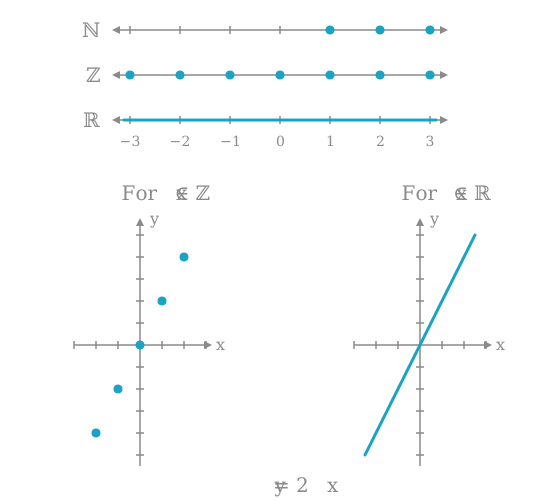
So every unbroken line you’ve ever drawn quietly assumed .
Then what can’t x be?
Dividing by Zero
The most important exception for you is dividing by zero.
Division by zero is undefined. Why?
Division undoes multiplication. So because . But every number multiplied by zero is also zero. So that means:
- For , no number works, because anything multiplied by zero is zero.
- Or for , every number works, meaning you don’t get a unique answer.
It kind of feels like you define as you can take infinitely many zeros out of any number. But that leads to insane results and breaks algebra:
- If , then:
- But also , then:
- So does ?
That is one of several reasons that mathematicians leave dividing by zero as undefined. The fact it doesn’t have a one-to-one mapping just makes it a wild ingredient to add in.
Conclusion: What you need to know: whenever appears on the bottom of a fraction, it can’t take any value that makes the bottom zero.
Square Roots of Negatives
First, the symbol always means the non-negative root, so , not . This is also called the principal root.
When we solve something like , we write . The is there because on its own only gives the positive root, but there are two solutions that square to solve the equation.
Now, from this logic, we know that no real number squares to give a negative, because a positive or a negative squared is positive and . So has no answer in the real numbers.
Note: Mathematicians invented a number to deal with this: where , giving another number set, complex numbers. They aren’t in A-Level Maths.
Conclusion: You will see the phrase “has no real solutions”. This is what that means. There are no real numbers that solve that equation.
When the Answer Doesn’t Fit Reality
Sometimes the limits on come from the context rather than the maths. A length or an area must be positive, time usually starts at , and you can’t have people.
Key Example: A rectangle has sides cm and cm, and an area of cm². Find .
Both solve the equation, but a length must be positive, so the only solution we count is .
Conclusion: You may need to disallow or throw away solutions to fit the context of a question.
What do you need to be aware of?
You’ll be expected to be more “Rigorous”
Mathematicians call this being more rigorous: making every assumption visible, so nothing is quietly taken for granted.
It matters because the same statement can be true or false depending on which set belongs to. Take ” is an even number”. For , it’s always true. For , it’s false: gives .
Conclusion: A statement or equation containing an algebraic term is only complete once we know which values that term can take.
Make sure you can read and write the conditions
The constraints and conditions are what changes the behaviour of an algebraic term:
- reads ” is a real number, and is not ”.
- reads ” is a natural number”.
- reads ” is an integer that is at least ”.
We can also describe a whole set of values with set-builder notation: reads “the set of all such that is not ”.
Look at the Proof for “1 = 2”
This proof is often wheeled out to show students how not being rigorous can lead to ridiculous results.
Key Example: Watch closely. Let and be equal, non-zero numbers, so :
So ? Wow, that’s wild…
Oh wait, we did something illegal. The culprit is the fourth line: since , we have , so we divided by zero. Every line before it was true. Every line after it is nonsense.
For A-Level, you need to be able to read these conditions and recognise the number sets. You need to learn to recognise all this new notation and over time you’ll know how to apply it yourself.