Introducing A-Level Maths
How to support this course
I plan to finish writing up the whole course as a free online revision textbook. If you'd like to help, you can:
- Share these resources with anyone who might find them useful
- Join our group tuition
- Give feedback
- Buy me a coffee
What is this?
This is an overview of the entirety of the A-Level Maths syllabus. It is written in the style I wanted to find but couldn’t, and I believe it can set you up to ace your exams. These resources are based around the Edexcel specification (specification code: 9MA0), but there will be overlap with other courses.
Structure & Style
This is aiming to be a concise but complete summary of the course, which could be viewed as a textbook of sorts, but I think will be best as a revision course that deepens and reinforces classroom learning. You could teach yourself with this as the primary source, but I would advise reading around it too and looking for other perspectives to help the concepts settle.
I’ve tried to compact what you need to know for the course down to the significant, so every line holds valuable meaning, both for the exam and for what this level of maths is really about, where we go beyond problem solving with a set of rules and methods, and start to test your understanding of the assumptions and consequences of those rules.
You don’t need to worry if you don’t deeply understand every line and every consequence on first read. Focus on getting the headline rules first. I would more hope that my students could have a good conversation about all the mathematical ideas we meet, and use this as a platform for asking the right questions to further their understanding.
What to expect ahead
Should you study A-Level Maths?
In my experience, maths is a subject well worth your time. Given time and effort, it should become the exam which you walk into most confident about what can happen and how you’ll ace it. It also opens countless doors, earns widespread respect, and expresses some of the most fascinating questions.
What changes from GCSE?
A-Level Maths is in many ways a jump up from what you’ve done before. This is where we start to use maths as a language, to represent logic and to deduce truths, which is what university-level maths really focuses on.
You still get the problem-solving and the satisfaction of finding a correct answer. However, rather than just looking for a solution to the problem, you’re asked to consider the assumptions that make that solution work, the consequences of what that solution tells us, and to use your understanding of that solution to solve related problems. Basically there is a lot more “If that is the answer, what does that mean? How can we use it?”.
What about maths beyond A-Level?
If you study maths beyond and above A-level, solving an individual problem becomes even less of a focus. You focus on writing mathematical proofs and being rigorous with your assumptions and logic. The goal is to understand why maths works in the first place and how mathematicians are extending it to discover new maths.
I and many of the students around me during my maths degree were surprised by quite how different the subject was at university compared to before. I ended up finding it more difficult but also significantly more meaningful. The trade-off is you get fewer satisfying one-off puzzles designed for you to solve, and instead you’re set free in a playground of “this is the language of logic and systems that everyone relies on, see if you can learn the language and maybe you can prove to us a new truth of the universe”.
What about now?
It’s helpful to appreciate the direction of where it is going because it helps you know what bits are important and how to handle the harder questions you’ll be thrown into. I’ve tried to bring some of that philosophy and rigour into this course (without getting too lost in the details of mathematical perfection).
I think then you can understand what you’re writing really means, and therefore what you can and can’t do. Ultimately, you end up understanding it so fluently that it becomes like reading a language (like you are now, without thinking).
How to use these resources
Our goal together
This course will try to illustrate why the new rules work through examples and proofs. I think it’s incredibly useful to be able to break down what maths notation means in terms of individual steps. If you can read a complex equation as the underlying basic operations and numbers, then you are far less likely to make a mistake when simplifying it, as you should always be able to prove to yourself whether your next step is still equal to what you had before.
Remember that maths notation is often about summarising operations so we have to write less to express complex things. We’ll discuss this a bit more later but as an example, multiplication is defined as repeated addition, hence it saves us writing an addition out as many times as we want to do it. Then beyond that, powers like squared or cubed are there to represent a repeated multiplication, and so within a power we have repeated multiplication which is repeated addition.
When in doubt, remember that all the maths you tangle with breaks down into simple bits. You just have to recognise the bits you already know.
How I would work through the course
I’d have two sheets of paper in front of me:
- Rough work: where I’d try each rule with my own numbers, test variations and add other ingredients to see how it all works.
- Revision notes: where I’d write each new rule neatly and colour-coded, with anything I found surprising and one or two examples of my own, writing up connections and insights that I see between the headline rules we need to internalise.
To see what I mean, here are my revision notes for the start of Rules of Indices.
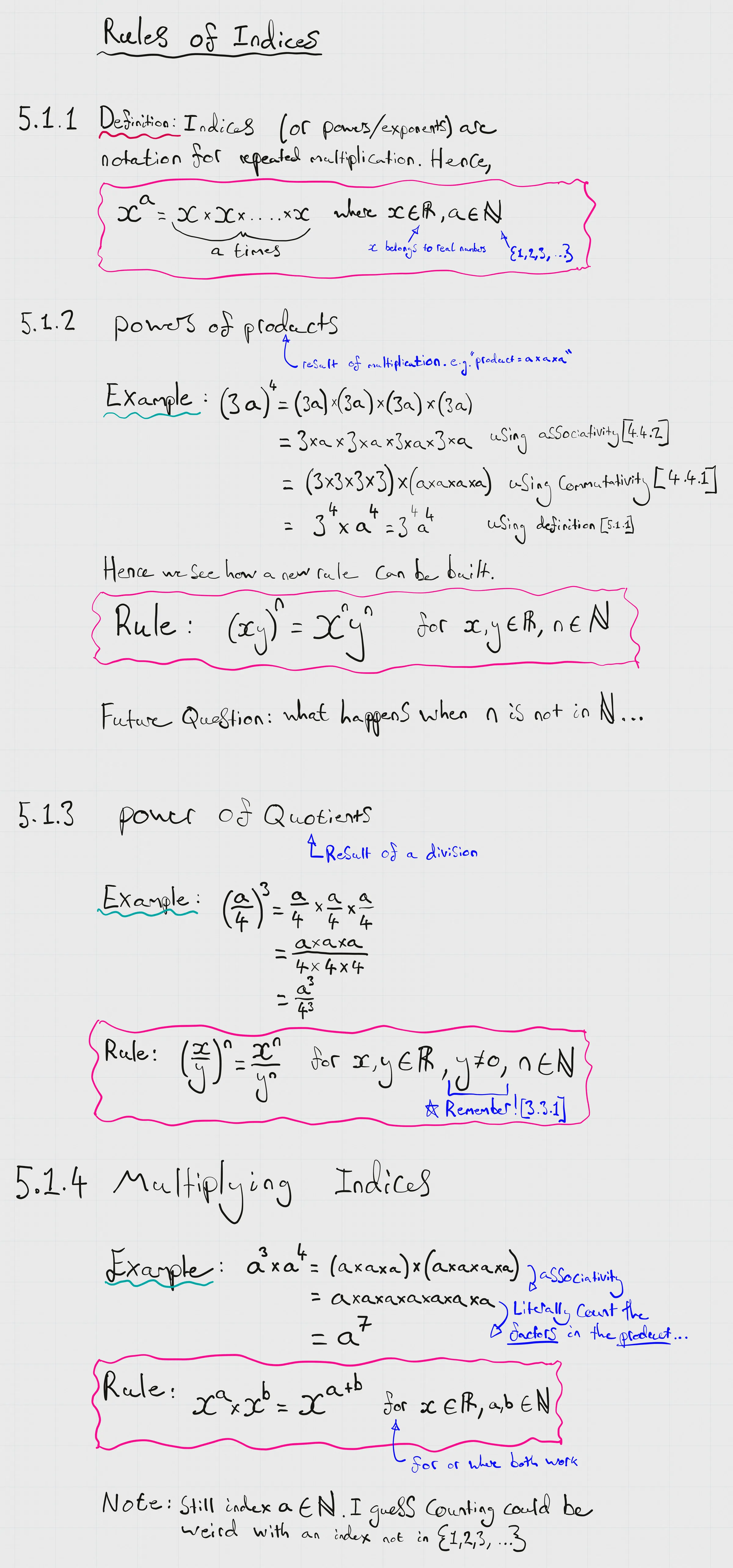
I’ve added notes at the top of sections about what you should focus on and how detailed your notes should be. For example, the first 4 sections are about introducing new concepts, examining assumptions, and reinforcing our foundations so we’re all on the same page. They don’t need rigorous notes but they contain important ideas to understand.
Condensing what you read into your own notes, in your own way, and inventing your own examples is what commits it to long-term memory. Just copying without thinking won’t stick nearly as well.
Maths is a written subject, and you’ll have to write it under exam conditions, so practice laying out your working to communicate clearly.
Once you cover everything you need to, go back to the areas you’re least confident on and see if a second run through reveals anything new.
Then once you have the concepts, maths is all about practice! The more questions the better. Remember that unseen past papers are a limited resource and to use them carefully in timed conditions to prepare yourself for the real thing.
Good luck out there
Personally I went from being an unconfident maths student, who despite always being told I was good at it felt it was too “hard” for me and only took it at A-Level so I could take physics. Then it became my favourite subject, which I studied at university, and it was the only subject where I was 110% confident of what could come up and how I would deal with it. Confidence is a finicky thing and I hope we can cultivate yours here.
The source of my confidence was I felt like I knew everything I needed to, and that made me much more assured. I’ve tried to lay out the course so you can see all the important content in one place, along with the depth to really understand what is happening, while making it as concise as possible so that you can work through it as revision.
My advice is try to work out the edges of the course material. Make it a tangible finite known quantity, rather than an infinitely sprawling mess with no end. Tick everything off a list. And practice, practice, practice, and you’ll do great. Good luck!
Optional Section: Where does maths come from? And why do I like it?
Did you know maths is a language?
Yes, maths is a language. Often referred to as the universal language. It is the language of logic, rules and systems. It is the language in which the universe is written (talk to Galileo Galilei if you doubt me).
“the universe cannot be understood unless one first learns to comprehend the language and interpret the characters in which it is written. It is written in mathematical language”
Galileo Galilei
Which is commonly summarised in the more poetic phrase:
“Mathematics is the language with which God has written the universe”
If you hear someone call maths beautiful, it likely relates to the conciseness and elegance of the language - whether it’s how a simple equation like Euler’s identity, , neatly combines completely different branches of mathematics, or how mathematical ideas like the golden ratio, the Fibonacci sequence, or are observed throughout nature.
The origins of the language
Did you know that the earliest human writing was actually mathematical symbols? The earliest known records of a writing system were cuneiform from ancient Mesopotamia over 5000 years ago. They were used to track quantities of production and stock of resources like grain. This tells us something about how useful mathematics is and about how old and dusty accountants really are.
Like the development and evolution of humanity’s spoken languages, there used to be more dialects and accents to maths notation, which have largely resolved into one global language of logic shared by mathematicians across the globe. This points at an interesting question at the heart of mathematics: if different cultures developed different symbols and representations of the same rules and relationships independently, is mathematics created or discovered?
Some of my favourite historical examples
Maths has a long history with wide-reaching influence. It has a finger in almost every pi.
Ludwig Wittgenstein’s philosophy is laid out like a mathematical text, with numbered statements and logic, but instead of proving mathematical statements, he wanted to prove the limits of language and what truths it could convey. His conclusion was: “Whereof one cannot speak, thereof one must be silent.” So perhaps we should all just shut up.
We’re used to maths being black and white, with clear answers. However, in 1931, Gödel’s incompleteness theorems lodged a philosophical thorn in the side of maths itself. He found a way to write, in pure maths, a statement that says “this statement cannot be proven”. If it could be proven, it would be false, so it must be true but unprovable. Then he showed that every consistent system of rules powerful enough to do arithmetic has truths like this that it can never reach.
Mathematics also provided Albert Einstein with the perfect language needed to express his theory of general relativity. After asking his mathematician friend Marcel Grossmann if a suitable representation already existed, he used tensors to describe gravity as the curvature of four-dimensional spacetime.
Meanwhile, probability models and predicts the wild consequences of quantum mechanics, which you may know from Schrödinger’s cat or particle collisions at the Large Hadron Collider. The union of general relativity and quantum mechanics into a complete consistent theory likely requires someone to make new discoveries in maths.
Finally, mathematicians have always held strong connections to the wildest imaginations and most out-of-this-world ideas. Many know that Alice in Wonderland was written by Lewis Carroll, but did you know that his real name was Charles Lutwidge Dodgson: an Oxford mathematician who wrote nonsense poetry as a hobby?
Some of my personal examples
I was bought a book called The Number Devil as a kid, and it introduced me to concepts like prime and Fibonacci numbers, and the properties of infinity. It’s a nice read to introduce big mathematical ideas to a young person. As a teenager preparing for my personal statement, I read a few books I would recommend:
- Flatland by Edwin Abbott points towards the question of how we can perceive higher-dimensional spaces. For example, if 3-D objects cast 2-D shadows under a light, then we can view the 3-D shadows that a 4-D shape would cast. This is what you can see if you look up hypercubes or tesseracts.
- I also read Alex’s Adventures in Numberland, which convinced me how interesting maths could be. I still think about chapters like how we use a base 10 number system even though it probably isn’t best, or that humans struggle to perceive large numbers and we can observe it getting fuzzy, or some classics like infinity or the golden ratio!
My reflection
Personally, I think maths is a wonderful subject. It’s surprising to follow where it connects and the questions it contains. Working as a Data Scientist and Game Developer also made clear to me how useful the skills are and, more than anything, the approach to problem solving it promotes. There is a reason people respect it so much. And remember, if it hasn’t clicked yet, that doesn’t mean it won’t. Take your time, get support, and draw on the community. This can be a lot of fun…